New Interview at Salon: A Conversation with Historian and Social Critic Morris Berman

Morris Berman, American historian, cultural theorist, and sociologist, is a starry eyed realist whose grim forecast of American demise makes him alone even in leftist circles. In the brilliant trilogy of books on American decline — “Twilight of American Culture,” “Dark Ages of America,” and “Why America Failed” — he surveys the political dysfunction, economic disrepair and cultural decay of modern America. Unlike most social critics, he does not end his analysis with a perfunctory prescription for revolution. Such optimistic talk, Berman makes clear, is the delusional noise of sounding brass and tinkling cymbals.

After chronicling America’s birth as a “nation of hustlers,” and exhaustively mapping its mutation into a vicious playground for the rich and prison for the poor, Berman has turned his eyes and pen to the East. His new book, “Neurotic Beauty: An Outsider Looks at Japan,” is a bracing, fascinating and challenging exploration of Japanese culture, politics, and ethics. The product of a lifelong fascination for Berman, “Neurotic Beauty” not only examines Japanese history and contemporary culture, but also the relationship between Japan and America, the conflict between individualism and collectivism, craft traditions alternative to consumer capitalism, and the possibility that Japan might emerge as a “post-capitalist” model for economics and politics.

I recently had the pleasure and privilege of interviewing Berman about his book, and his forecast for Japan and America.

Read the interview at Salon.

BermanJapan

New Essay at Salon: The Military is Buying Patriotism

In a new essay for Salon, I analyze how America has become a garrison state and military economy by dealing with the recent scandal of the Pentagon paying the NFL to ceremoniously honor soldiers and veterans before kickoff and during halftime.

The essay examines America’s militarized culture in which it becomes easy to glorify war and condemn advocates for peace, but it also explores the economics of the American government, where half of discretionary spending goes to the military. Such a large percentage of every dollar leaves little room for schools, hospitals, libraries, public transit, infrastructure, and social services – the hallmarks of civilization.

Read it in full at Salon.

New Article at AlterNet: Interview with Stacy Bannerman

I recently had the privilege and pleasure of speaking with Stacy Bannerman, a true hero of American life.

From the opening of the article:

Stacy Bannerman is an elegant, but intense amplification of American conscience competing with a cacophony of cruelty and neglect. In 2003, her husband, a member of the Army National Guard, was mobilized to fight in the Iraq War. She summoned the passion of her personal investment, along with the knowledge of her education – a Bachelor’s Degree in International Relations – to act as a board member of Military Families Speak Out, the largest anti-war organization comprised of military families.

Her advocacy for peace and veteran’s care quickly commenced a confrontation with the consequences that ensue “When,” to quote the title of her book, “The War Came Home.”

Bannerman has now become a leading advocate for the spouses and children of combat veterans. Thousands of women become casualties of America’s wars when their partners return from the battlefield, often with Post Traumatic Stress Disorder or Traumatic Brain Injury, and target them for assault and violence. Department of Defense and Veterans Affairs studies both demonstrate that rates of domestic violence are dramatically higher in homes where one parent served in a combat role, and the Army Times recently reported that since 2009, child abuse in Army families has risen by a staggering 40 percent.

In the words of Bannerman, “The veterans enlisted. Their families were drafted.”

The lack of attention politicians and pundits give to crises of abuse and neglect in veteran families is criminal. Bannerman has dedicated her life to bringing comfort and consolation to spousal abuse victims, and more importantly, fighting to convince the political establishment – at the state and federal levels – to allocate resources to assist and protect the women and children whose real combat begins when their family member in uniform receives his discharge. She has testified in front of the House and the Senate, and met with over 80 Congressional representatives. Stacy has argued for the passage of the Kristy Huddleston Act, a bill that she wrote and named after a close friend, whose combat veteran husband murdered her.

Bannerman continues the story she began with When The War Came Home in her newest book, Homefront 911 (http://www.amazon.com/Homefront-911-Veterans-Families-Wounded/dp/1628725699/ref=as_at?tag=thedaibea-20&linkCode=as2&) an important and insightful look at how war destroys the lives of military families.

I recently discussed Stacy Bannerman’s heroic work with her on the phone…

Read the interview at AlterNet, and learn about one of the most important moral and gender issues of American politics. It is an indictment of the feminist left, American government, and mainstream media that the threat military spouses face as a matter of routine does not receive more coverage and provoke more outrage.

Commentary at Fusion – Anti-Gay Law in Indiana, Chicago Mayoral Race

The new media company Fusion, a collaboration between ABC News and Univsion, requested that I write about some issues particularly relevant to my region.

In the first, an essay on the Religious Freedom Restoration Act, I explain that the hideous and ridiculous anti-gay law was Governor Pence’s fumbling and bumbling attempt to ingratiate himself to the religious right for a presidential run in 2016. The entire controversy doubles as an indictment of the extremity of the Republican base, which rejected Pence’s predecessor, Mitch Daniels, from presidential consideration because of his comparably moderate record on social issues.

In the second, I offered an endorsement of Jesus “Chuy” Garcia in the Chicago Mayoral Race.

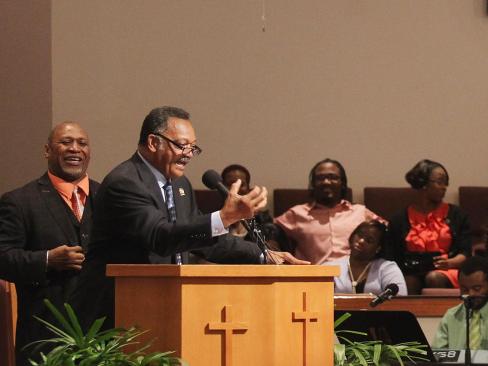
New Essay at Patheos – Religious At The Back of The Bus: An Interview with Rev. Jesse Jackson

For Patheos‘  feature on the 50th anniversary of the march on Selma – the real birth of American democracy – I interviewed Rev. Jesse Jackson about his Christian faith, the history of the religion, and how he applies his own spiritual devotion to his political activism and civil rights leadership.

From the essay:

The central problem of American politics and culture predates the country’s existence by nearly two thousand years. It is the same conflict at the heart of a close cousin to the American experience.

Sitting in the office of Jesse Jackson, whose political activism and civil rights leadership often cause people to forget he was first and is still an ordained minister, easily becomes a church experience when he launches into a sermon. All I needed to do was remind him of the topic of our interview (religion in America), and he transformed his desk into a pulpit and my chair into a pew, giving a homespun homily connecting religion with politics, theology with culture, and the past with the present.

Read Rev. Jackson’s profound insights and the rest of the essay at Patheos.
<> on March 25, 2012 in Sanford, Florida.

New Essay at AlterNet: Why Libertarianism is a Childish Sham

In my latest essay for AlterNet, I expose how libertarianism is an exercise in conformity and childish delusions.

Rather that rebelling, libertarians conform to the worst and most dominant aspects of American culture. Rather than acting as a political movement, it is actually the expression of an anti-political impulse.

From the essay:

As much as libertarians boast of having a “political movement” gaining in popularity, “you’re not the boss of me” does not even rise to the most elementary level of politics. Aristotle translated “politics” into meaning “the things concerning the polis,” referring to the city, or in other words, the community. Confucius connected politics with ethics, and his ethics are attached to communal service with a moral system based on empathy. A political program, like that from the right, that eliminates empathy, and denies the collective, is anti-political.

Opposition to any conception of the public interest and common good, and the consistent rejection of any opportunity to organize communities in the interest of solidarity, is not only a vicious form of anti-politics, it is affirmation of America’s most dominant and harmful dogmas. In America, selfishness, like blue jeans or a black dress, never goes out of style. It is the style.

Read the rest at AlterNet.

New Essay at AlterNet: America’s Decay Into a Violent, Cruel Place

Historian Morris Berman brings all the analyses of America’s decline and decay in a violent and cruel culture of greed and selfishness to a “question of values.” Most liberals and leftists are rightly critical of American institutions – the avarice of corporations, the corruption of government, the ruthlessness of the Pentagon, and the idiocy of the media.

The detached abstraction of American dysfunction is how most critics also explained the Michael Brown and Eric Garner killings, and the subsequent release of the officers responsible without charges or trials. Everyone blamed “the system”, as if the system is a giant computer.

What most critics ignored is that in both cases, and many similar cases, grand juries of twelve Americans review the evidence, and coldly release the killers. The criminal justice system is structurally racist, but the system is powered by people. The values of the  majority of the American people are dangerous. The sane minority protests in the street, while the silent majority of Nixon’s delight sits comfortably in their living rooms. The same silent majority supports war, approves of torture, and applauds the cutting of social services.

Those that do not actively promote the cruelty and violence of the status quo are disengaged and disinterested. According to a study from Newsweek, 70 percent of Americans cannot name a single part of the Bill of Rights.

It is the battle of the sane minority and the silent majority that is the subject of my new essay for AlterNet.

New Essay at Salon: My Week in the Right Wing Lie Machine

In my new essay for Salon, I react to the reaction my essay on America’s idolatry of the military. I expand on America’s indifference to the rape epidemic within the military. I describe my own personal connection with veterans (my grandfather, my father, and former students), and I analyze the meaning of the death threats and hateful campaign my article provoked. The poison of propaganda from Fox News and right wing media became clear, as did the hideousness of the social media sewer.

Most importantly, I write about the moving story of Fred John Boenig, and his son, Austin, who committed suicide while serving in the Air Force in Afghanistan. Fred and I spoke at length on the phone after the publication of my original essay on the military. His kindness and honesty moved me profoundly, and the journey of his son is worthy of mourning, but also examination from all Americans.

Read the essay at Salon.

New Column for the Indianapolis Star: Israel Oppresses Palestinians, with US Assistance

In my latest column for the Indianapolis Star, I lay out some basic facts of Palestinian suffering at Israeli hands. It is a regime of human rights violations, abuse, and violence that U.S. supports with military, financial, and diplomatic aid.

In the column, I reference the work of Gregory Harms, who is an immensely important voice of reason, clarity, and sanity on the crime of the Israeli Occupation.

Read it here.