Jim Harrison, R.I.P.

The stillness of this earth
which we pass through
with the precise speed of our dreams
– Jim Harrison, Returning to Earth, 1977

When I announced to my mother the sad news of Jim Harrison’s death, she said, “He was your buddy.”

At first I found the comment odd. Although he was my favorite living writer, I had never met the man. My mother was not confused. She understood exactly what she was implying, and after a few moments of introspection, I was able to reach into the darkness of my own mind, and grasp onto the small piece of truth in my own experience as a person dedicated to reading and making sentences.

A good friend and former teacher of mine, Roger, recommended I read Harrison’s breakout collection of novellas, Legends of the Fall, when I was in college. Before I could make good on his wise advice, he called me; “Don’t buy the Harrison book. I just went to Borders and bought it for you.”

When I saw him a few weeks later, I did not realize that when he placed the book in my hand, he was not merely passing on a literary gift of excellence. My old friend was introducing me to a new friend.

Jim Harrison once said that he read more for “strength than pleasure.” With Harrison’s own novels and poetry, I found an abundance of both, and his hard-boiled beauty was much like an endless supply of life affirming water to continually help fill the reservoir of my spirit.

I read and reread many of his books, always seemingly able to alchemize his poetry and story into a centering force in my life. His words, as a writer but more importantly as a man, helped me get my bearings, and reminded me of what truly has value in a world too often eager to evaluate everything according to a commercial criterion. If there is one glimpse into reality a reader can consistently get from Harrison it is that life is for enjoyment, pleasure, love, and artistry. Any person who still registers a pulse must aggressively tackle all of the opportunities of life with gusto.

The cruel teacher of trauma inculcated this wisdom in Harrison. His father and sister died in a car wreck when he was in his late teens, and it was in the fog of his grief that he saw his own life clearly. He thought that if two people could be taken out of the world so arbitrarily, there was no point in not doing what you wanted to do. He did what he wanted for decades, making an invaluable contribution to American literature.

Like a true friend, Harrison challenged and comforted me, and in a bastardization of what Mikhail Bahktin called, “the dialogic of the novel,” I developed an internal discussion with Harrison, often drawing on that discussion in moments of tragedy and triumph, pain and pleasure, joy and confusion.

In 2010, following the publication of my first book, Working On a Dream, my mother invited me over to my parents’ home to celebrate. We toasted my marginal literary success with a glass of wine from an expensive French bottle that my mother bought because she read that it was Jim Harrison’s favorite.

My book was a hybrid of musical criticism and political commentary about Bruce Springsteen. It was vastly different from anything Harrison ever wrote, and not nearly as good, but with its publication I felt that I, at a minimum, acquired a ticket of entry onto the great ship of my imagination. Jim Harrison was one of my heroes in the captain’s quarters, and I was somewhere deep in the bowels, but I found great pride in the fact that I made it on board.

Harrison was my buddy, but a buddy of a different sort. I never met him, but he seemed like a man of madness. He ate madly, fucked madly, drank madly, wrote madly, but most of all, loved madly. He loved his family, his wife, his friends, his animals, and the natural world.

I can love a little fuller and a little deeper for having read his books.

I wrote about Jim Harrison’s series of novellas about an indelible and lovable character, Brown Dog, for the Daily Beast – “The Legend of Brown Dog: A Great American Hero Gets His Due.”

In an unlikely coincidence, my latest essay, published by Salon just a few days before Harrison’s death, is a review of his newest book – “Want To Reject American Puritanism, Workaholism, and Toxic Obsession with Stuff? Read Jim Harrison’s Books.”

wkd-jim-harrison


New Essay at Salon: Who The Hell Are These Trump Supporters?

In my new essay at Salon, which caught hell from conservatives and liberals, I review the data, and draw some logical and reasonable conclusions about Donald Trump’s supporters.

The conclusions are not pretty, but given what Trump has already done, and promises to do, to the United States, they are deservedly hideous.

Read the essay at Salon.

Interview with Dawn Porter, Documentarian, at AlterNet

In a new feature at AlterNet, I interview documentary filmmaker, Dawn Porter, about her important and moving new film, Trapped.

Trapped tells the story of abortion practitioners, and the women they serve, in Southern states where prohibitive regulations have all but stripped away the constitutional rights of women seeking reproductive health services.

Read the feature at AlterNet, and keep an eye out for the film, which is set to air on PBS soon.

Happy New Year

Happy New Year, everyone. This website has been static for the past two months, and I do apologize for my negligence.

I’ve been busy writing about everything from terrorism to the godfather of heavy metal, Lemmy Kilmister, at Salon and the Daily Beast.

Like everyone else, I too have written about Donald Trump. I’ve written about religion, economics, and politics, but also about more pleasant topics such as the aforementioned work of Motorhead, the literature of Gore Vidal, and the novels of Jim Webb.

The Daily Beast ran an excerpt from my book on John Mellencamp, while my book on Metallica has received press and great reviews from Consequence of Sound, Record Collector, Illinois Entertainer, and the Chicago Music Examiner.

Make sure to follow this space throughout 2016 for more essays on politics, culture, literature, and music, and for a major update on my next book.

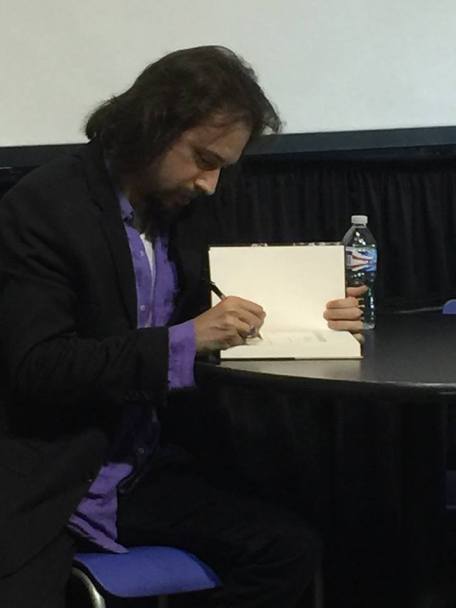
Book Signing

New Article at AlterNet: Interview with Stacy Bannerman

I recently had the privilege and pleasure of speaking with Stacy Bannerman, a true hero of American life.

From the opening of the article:

Stacy Bannerman is an elegant, but intense amplification of American conscience competing with a cacophony of cruelty and neglect. In 2003, her husband, a member of the Army National Guard, was mobilized to fight in the Iraq War. She summoned the passion of her personal investment, along with the knowledge of her education – a Bachelor’s Degree in International Relations – to act as a board member of Military Families Speak Out, the largest anti-war organization comprised of military families.

Her advocacy for peace and veteran’s care quickly commenced a confrontation with the consequences that ensue “When,” to quote the title of her book, “The War Came Home.”

Bannerman has now become a leading advocate for the spouses and children of combat veterans. Thousands of women become casualties of America’s wars when their partners return from the battlefield, often with Post Traumatic Stress Disorder or Traumatic Brain Injury, and target them for assault and violence. Department of Defense and Veterans Affairs studies both demonstrate that rates of domestic violence are dramatically higher in homes where one parent served in a combat role, and the Army Times recently reported that since 2009, child abuse in Army families has risen by a staggering 40 percent.

In the words of Bannerman, “The veterans enlisted. Their families were drafted.”

The lack of attention politicians and pundits give to crises of abuse and neglect in veteran families is criminal. Bannerman has dedicated her life to bringing comfort and consolation to spousal abuse victims, and more importantly, fighting to convince the political establishment – at the state and federal levels – to allocate resources to assist and protect the women and children whose real combat begins when their family member in uniform receives his discharge. She has testified in front of the House and the Senate, and met with over 80 Congressional representatives. Stacy has argued for the passage of the Kristy Huddleston Act, a bill that she wrote and named after a close friend, whose combat veteran husband murdered her.

Bannerman continues the story she began with When The War Came Home in her newest book, Homefront 911 (http://www.amazon.com/Homefront-911-Veterans-Families-Wounded/dp/1628725699/ref=as_at?tag=thedaibea-20&linkCode=as2&) an important and insightful look at how war destroys the lives of military families.

I recently discussed Stacy Bannerman’s heroic work with her on the phone…

Read the interview at AlterNet, and learn about one of the most important moral and gender issues of American politics. It is an indictment of the feminist left, American government, and mainstream media that the threat military spouses face as a matter of routine does not receive more coverage and provoke more outrage.

Mellencamp: American Troubadour is Now Available!

My new book, Mellencamp: American Troubadour, is now officially available from the University Press of Kentucky, and all book retailers.

Salon recently ran an excerpt, and it is already receiving high praise.

Part biography, part cultural and sociological commentary—with a touch of hagiography/fan nonfiction thrown in—Mellencamp is almost a new genre. Masciotra’s observations, contributions, and asides are apt and diverse. Both Mellencamp’s work and the man himself are deeper than they appear, and this book really shores this up. — Susan Compo, author of Warren Oates: A Wild Life

David Masciotra writes with the precision and integrity and humanity of a great journalist, one whose word you can trust. He knows his subject, and his prose and reporting are always informed by the lights of compassion and decency. — James Lee Burke, author of Wayfaring Stranger

For almost 40 years, John Mellencamp has been forging a path through the thickets of the music industry, meditating on the connections between rock, soul, folk and funk. In the process, he’s established himself as a major artist whose work is sometimes obscured by the shadows of Bob Dylan and Bruce Springsteen. In this detailed, loving book, David Masciotra shines the light of his critical intelligence on the connections between Mellencamp’s life, his music, and the commitment to a deeper understanding of our shared humanity. — Craig Werner, author of Up Around the Bend: An Oral History of Creedence Clearwater Revival

Mellencamp_final.indd

New Article at Splice Today: Ruthie Foster and The Gospel Impulse

One of the most talented, moving, and inspirational singers in American music is the phenomenal Ruthie Foster. More than nearly any other contemporary American singer, she expresses, exercises, and exemplifies what Craig Werner calls the “gospel impulse.” In my new essay for Splice Today, I write about the importance of Ruthie Foster’s music, and the deficit American culture suffers for not giving her a bigger platform to share with the world her unique and powerful voice and vision. Read it here. Ruthie Foster’s new single, “Singing The Blues.”

New Essay At Truthout: A Day With Jesse Jackson and A Look At the Failures of American Capitalism

I recently had the pleasure and honor of spending Jesse Jackson’s birthday with the civil rights leader and his staff.

Following him from event to event at Chicago’s poor public schools, and discussing a wide variety of issues, gave a perfect demonstration of the layers of discrimination and obstruction that exist in American culture.

Jackson said that “we must have the courage to reimagine our struggle.” The reimagining requires that we see the layers at the lowest level, but also the highest level in corporate America and the world of high tech.

Read it here.

New Essay at Salon: You Don’t Protect My Freedom

Easily, my most read and controversial essay is criticism of how idolatry of the military prevents American culture and politics from acknowledging and addressing the important issues of sexual assault within the military and a war friendly foreign policy.

Calling every troop and veteran a “hero”, and ending the conversation there, is inaccurate – even though some are heroes – but also irresponsible. The conversation must continue to include questions about the culture within the military that allows for one third of all women serving to suffer sexual assault, and the politics of the American government that, in the words of Gore Vidal, a World War II veteran, keeps us at “perpetual war.”

Thousands of people who sent me hate mail and death threats, along with the commentators of Fox News, attacked me, without actually reading the article, for “hating the troops.” Such a slander is pure nonsense.

Read it and find out yourself.

New Essay for the Daily Beast: Cornel West’s Disappointing Decline

For many years, one of the most important influences in the development of my thinking and writing was Cornel West. Many of his early books, along with the experiences I had watching him deliver moving and provocative lectures, were essential to the cultivation of my own political perspective, sense of cultural engagement, and philosophical framework.

Over the past few years, however, West has transformed from an intellectual into a celebrity, and in doing so, he has fallen into the American media trap of relying on slogans, recycling soundbites, and regurgitating a greatest hits of his analytic history. He’s also told obvious lies about major figures. For example, claiming that President Obama “cussed him out” in front of dozens of witnesses, none of whom have ever come forward to confirm West’s account. West claims the incident happened after Obama’s address to the National Urban League a few years ago. It seems that if the President of the United States cussed out a public intellectual in front of journalists and witnesses, someone besides West would have noticed.

My latest essay for the Daily Beast tracks West’s decline, focusing primarily on his new book. Black Prophetic Fire, West’s new collection of interviews, is a strange and sad culmination of his metamorphosis from philosopher to television personality. He offers little depth on any subject he tackles in the book, often criticizes people without supporting his critique with evidence, and praises people because he knows them personally. The concept of the book is brilliant, and if it were better, it would serve as a wonderful introduction to one of the world’s most important traditions – the radical African American improvement of American democracy, resulting in immeasurably important contributions in politics, law, literature, theology, sociology, art, and philosophy. Unfortunately, West doesn’t seem to take the project seriously.

My essay gives a detailed account and analysis, and you can read it here.

The response to my essay has been fascinating. First, I know West has gained great popularity, but I had no idea that, as he acquired fame, he has become a secular god. Staggering amounts of people sent me emails of such anger, I could almost picture them foaming at the mouth as they hit the “send” button. Most interesting about these emails, is that none of them actually mounted a defense of West against the reasonable points I make in my essay. Many resorted to attacking me personally, and many others offered only vague arguments for West’s activism, which I myself praise in the article.

I’ve long suspected that most of the people who comment on essays on the internet do not actually read the essays. NPR has conducted experiments that confirm my suspicion, but my essay on West offers pretty devastating evidence. Many people who leave comments make statements that are directly refuted by my article. Space and time don’t permit me to leave every example, but I’ve selected a few comments that represent dozens more of their kind, and I’ll show how quotes taken from my essay contradict the comments.

So you’ve bought into the “How dare anyone criticize Obama!!” silliness, eh? Please, tell me how his criticism of Obama’s increasingly center-right, non-transparent, dishonest, flip-flopping administration lessens in any way Dr. West’s “intellectual chops?”

“Black Prophetic Fire aims to serve an important purpose in an era when there is increasing pressure and lucrative rewards for black leaders to follow the Barack Obama-Deval Patrick-Cory Booker model by moderating, moving to the center, and after gaining power, governing as a soft Democrat…The ascendancy of black leaders to the White House, the Senate, and governors’ mansions, contrary to the assumptions of conservatives and moderate Democrats, does not nullify the need for a Black freedom movement that furthers the march of icons West identifies in his new book. Mass incarceration, vicious educational disparities and segregation along racial lines, police brutality, and lack of opportunity for economic mobility among the black poor do not cause less pain, break fewer hearts, or magically vanish because Barack Obama became president. Critical and radical thinkers like Cornel West are necessary to confront an America too quick to fall into the cultural blindness and political complacency of “post-racial” mythmaking.”

In other words. The author likes West when West agrees with the author.

“For historical and political reasons, the concept of Black Prophetic Fire is excellent. It’s the delivery that’s awful.”

This is a stupid attempt to smear a great scholar.

“The publication of West’s most popular book, Race Matters, in 1993 demonstrated that he was one of the best cultural critics in American political debate. He could combine compelling elements from sociology, philosophy, and economics to present a challenging, but fascinating account of American race relations, democracy, and popular culture. During the height of the hideous Bush years, West brewed the same intoxicating tonic with Democracy Matters, and in doing so, gave beleaguered leftists the intellectual space to make sense of the Bush-Cheney nightmare of international aggression and domestic regression, and enough spiritual nourishment to inspire hope for a better day in American politics. West has also offered essential examinations of the essence and importance of African-American Christianity in Prophesy Deliverance!, his first book, and Prophetic Fragments.”

—–

I could go on like this with several more examples. Disagreement with my ideas and analysis does not bother me. I welcome debate and discussion, but comment sections on websites seem to empower the insane, shallow, and overly emotional. It is for this reason that I applaud Ta-Nehisi Coates for often forbidding comments on his essays. If people are going to angrily attack writers for their written work, the least they can do is read that work.